.png)
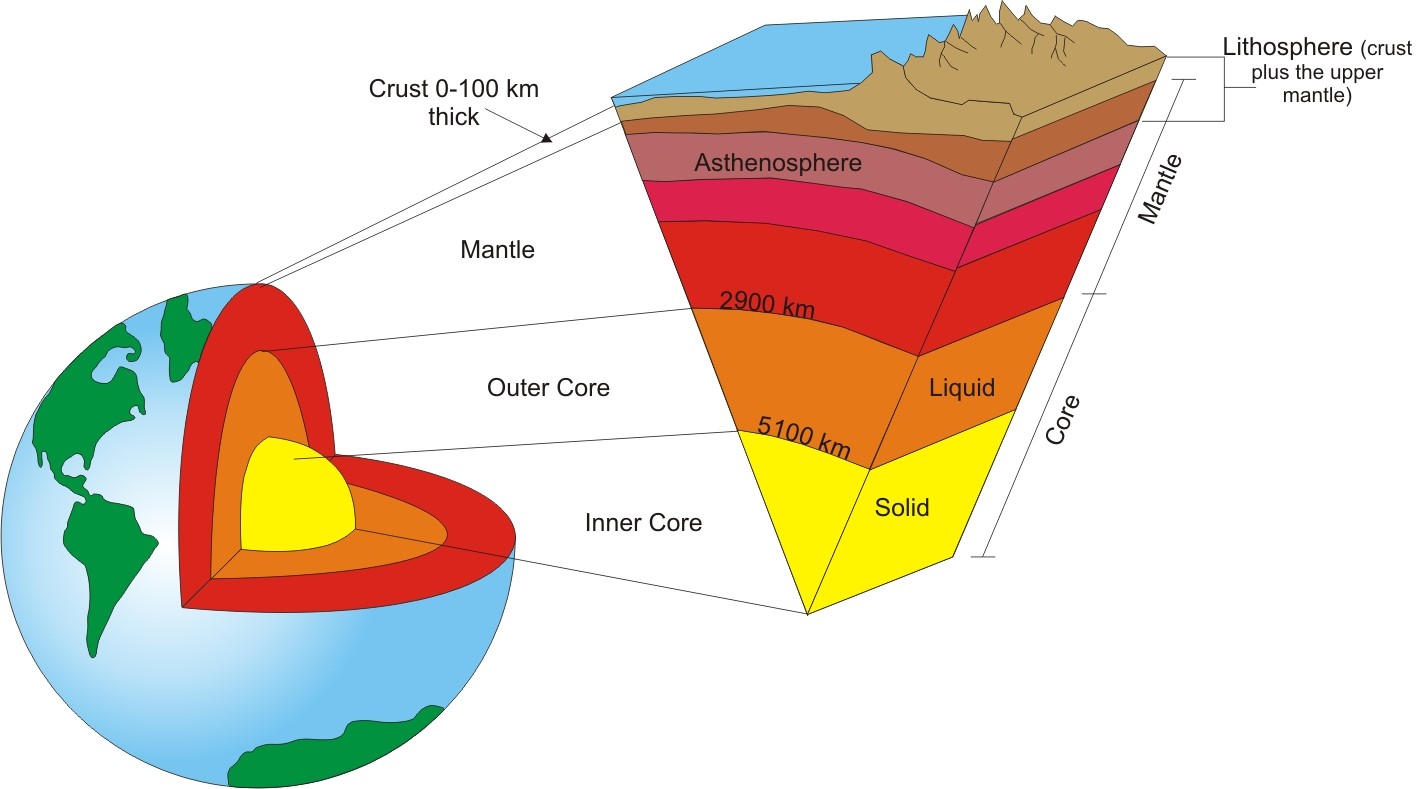

- Earth’s outer surface is its crust; a cold, thin, brittle outer shell made of rock. The crust is very thin, relative to the radius of the planet. There are two very different types of crust, each with its own distinctive physical and chemical properties.
Oceanic crust is composed of magma that erupts on the seafloor to create basalt lava flows or cools deeper down to create the intrusive igneous rock gabbro. Sediments, primarily muds and the shells of tiny sea creatures, coat the seafloor. Sediment is thickest near the shore where it comes off the continents in rivers and on wind currents.
Continental crust is made up of many different types of igneous, metamorphic, and sedimentary rocks. The average composition is granite, which is much less dense than the mafic igneous rocks of the oceanic crust. Because it is thick and has relatively low density, continental crust rises higher on the mantle than oceanic crust, which sinks into the mantle to form basins. When filled with water, these basins form the planet’s oceans.The lithosphere is the outermost mechanical layer, which behaves as a brittle, rigid solid. The lithosphere is about 100 kilometers thick. The definition of the lithosphere is based on how earth materials behave, so it includes the crust and the uppermost mantle, which are both brittle. Since it is rigid and brittle, when stresses act on the lithosphere, it breaks. This is what we experience as an earthquake.
Mohorovičić Discontinuity or Moho - it is the substantial change in seismic velocity at the base of the crust. In 1909, it was discovered by Andrija Mohorovičić by studying the earthquake wave paths in Croatia. Underneath the ocean, the Moho is about 5 km down. On the other hand, it is about 30-40 km under continents, except near a sizable mountain-building event which is known as an orogeny, in which the thickness doubled.

- The two most important things about the mantle are: (1) it is made of solid rock, and (2) it is hot. Scientists know that the mantle is made of rock based on evidence from seismic waves, heat flow, and meteorites. The properties fit the ultramafic rock peridotite, which is made of the iron- and magnesium-rich silicate minerals. Peridotite is rarely found at Earth’s surface. Scientists know that the mantle is extremely hot because of the heat flowing outward from it and because of its physical properties.

- At the planet’s center lies a dense metallic core. Scientists know that the core is metal for a few reasons. The density of Earth’s surface layers is much less than the overall density of the planet, as calculated from the planet’s rotation. If the surface layers are less dense than average, then the interior must be denser than average. Calculations indicate that the core is about 85 percent iron metal with nickel metal making up much of the remaining 15 percent. Also, metallic meteorites are thought to be representative of the core. If Earth’s core were not metal, the planet would not have a magnetic field. Metals such as iron are magnetic, but rock, which makes up the mantle and crust, is not. Scientists know that the outer core is liquid and the inner core is solid because S-waves stop at the inner core. The strong magnetic field is caused by convection in the liquid outer core. Convection currents in the outer core are due to heat from the even hotter inner core. The heat that keeps the outer core from solidifying is produced by the breakdown of radioactive elements in the inner core.
.png)
No comments:
Post a Comment